
The Drop and Roll Program
Voter Education and Outreach
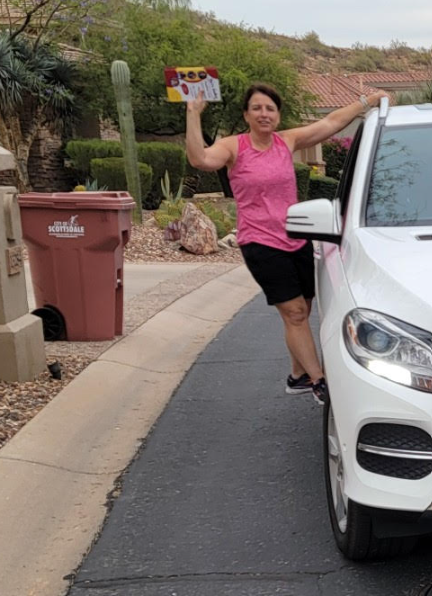
Most Voter Outreach Competes for Attention. This One Doesn’t.
Think about what happens to a door hanger. It gets pulled off, glanced at for half a second, and dropped in a pile with the pizza coupons and the lawn care flyers. If it makes it inside the house at all, it is already losing a competition it never asked to enter.
Drop and Roll enters a different game entirely.
Here’s How It Works
When the trash can is at the end of the driveway, you know the voter is home. On trash day, your target voter does something they do every single week: they walk to the end of their driveway and retrieve their trash can. It takes thirty seconds. They are alone. There is nothing else in their hands. And adhered to that trash can — the one they are already touching, already pulling back toward the house — is your message.
No competition. No noise. No pile of flyers to sort through.
Just your leaflet and a voter who is already paying attention because their hands are on the thing.
That is the Drop and Roll.
The Access Nobody Else Has
Drop and Roll is also one of the only voter outreach programs that works where traditional canvassing simply cannot go.
Long driveways. Gated entries. Rural properties set back from the road. Neighborhoods where a canvasser on foot would never reach the front door — or would never be welcome trying. These are the voters that door-to-door programs routinely skip, not because they are unreachable, but because the standard playbook was not designed for them.
But on trash day, those voters come to you.
The trash can sits at the end of that long driveway, at the edge of that gated community, at the road in front of that rural property. Your Dropper is there in seconds. Your message is placed. And when the voter retrieves their can, your leaflet makes the trip back to the house that no canvasser could reach.
| Drop and Roll reaches voters that every other outreach program leaves behind — not because those voters are disengaged, but because no one has found a way in. Until now. |
The Three-Person Team
Every Drop and Roll run operates with three people, each with a locked-in role. This is not a loose suggestion — the discipline of the three-role structure is what makes the program fast, accurate, and scalable.
The Driver
Keeps the vehicle moving efficiently through the route. Focused entirely on the road, the pace, and the flow of the run. The Driver does not navigate and does not drop. One job. Do it well.
The Navigator
This is the tactical brain of the operation. The Navigator works from the voter list — knowing which houses are targets, which trash cans belong to the right voters, and keeping the Driver on course without hesitation or backtracking. The Navigator calls the approach, tracks completed drops, and ensures the team stays on target voters only.
Precision here is what separates a productive run from a wasted morning. A strong Navigator is worth more than any other single variable in the program.
The Dropper
Positioned for fast exit and re-entry, the Dropper adheres the leaflet to the target trash can and is back in the vehicle before the neighborhood notices anything happened. Speed and accuracy. One clean motion per can. The Dropper does not improvise — they execute the Navigator’s call.
Why It Works — Every Time
The genius of Drop and Roll is not the leaflet. It is the moment of retrieval.
When a voter pulls their trash can back up the driveway, they are not distracted. They are not scrolling. They are not being interrupted. They are doing one thing — and your message is the only thing attached to it. There are no competing leaflets on that can. There is no stack to sort through. It is your content and their full, undivided attention.
Voter outreach has been trying to manufacture that moment for decades. Drop and Roll finds it where it already exists, every single week, reliably and for free.
| You know the voter lives there — they put the can out. You know they’ll retrieve it — they always do. You know they’ll see your message — it’s the only thing on the can. That’s not outreach. That’s a guaranteed read. |
Running a Successful Drop and Roll Operation
Before the run:
- Pull your target voter list for the area — focus on low-propensity Republican voters who are registered but have inconsistent voting history
- Map the route by trash day schedule — different streets in a neighborhood may have different pickup days
- Prepare your leaflets — content should be clean, direct, and action-oriented with a clear message about the election, deadlines, or a specific call to action
- Brief all three team members on their roles before the vehicle moves
During the run:
- The Navigator drives the operation — Driver and Dropper follow the Navigator’s calls
- Target only confirmed voter addresses on your list — do not improvise drops
- Move at a consistent pace — hesitation draws attention; efficiency does not
- Log completed drops in real time so the list stays current
After the run:
- Record completed addresses and flag any that were missed for a follow-up run
- Track ballot return rates for Drop and Roll addresses after ballots are issued — this is your performance data
The Bottom Line
Every other outreach program asks you to fight for attention in a crowded space. Drop and Roll gives you a moment of guaranteed, uncontested contact with a voter who is already in motion toward their front door.
It works in dense suburban neighborhoods. It works on rural routes with half-mile driveways. It works in gated communities where canvassers never get past the entrance. It works because it is built around something the voter is already doing — and it places your message exactly where they cannot miss it.
Three people. A vehicle. A list. And a leaflet that makes the trip home every single time.