
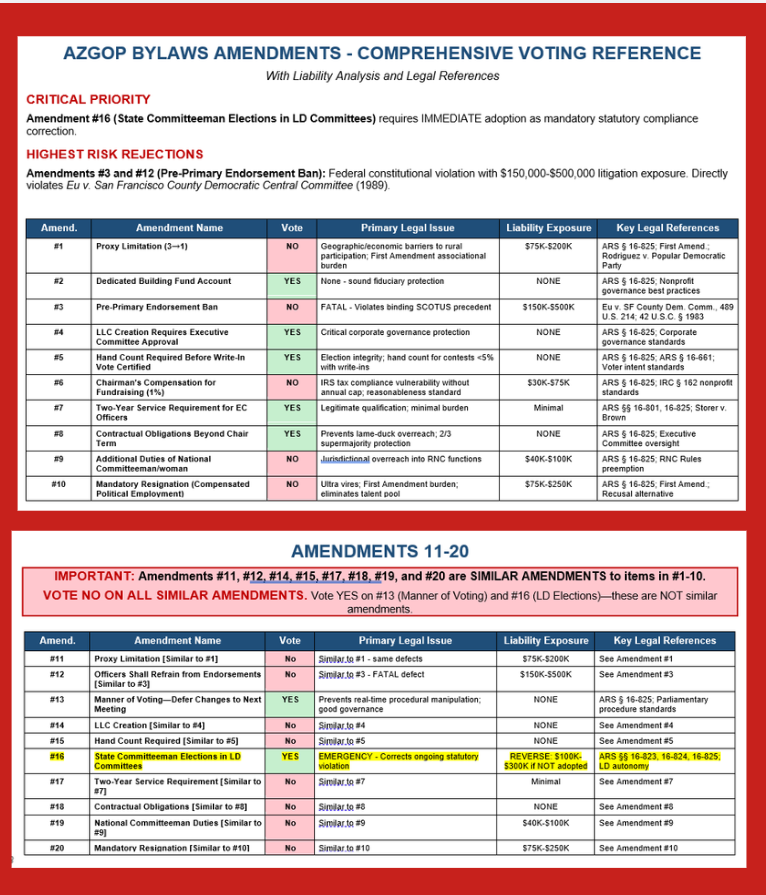
PROPOSED BYLAW CHANGE 1
Proxies at State Meetings (3→1 Reduction)
Submitted by: Bylaws Committee (Multiple Counties)
Committee Vote: FAILED 7-0
Legal Holdings:
- Statutory Authority: Compliant with ARS § 16-825
- Constitutional Status: Moderate-High Risk—creates geographic and wealth-based barriers to political participation
- Single annual meeting structure intensifies exclusion concerns
- Rural members face $500-700 participation cost vs. minimal urban burden
VOTE RECOMMENDATION: NO
Rationale: Committee’s unanimous rejection demonstrates sound constitutional judgment. Arizona’s geographic magnitude combined with single annual mandatory meeting creates First Amendment associational access concerns under Anderson-Burdick balancing. Current three-proxy limit adequately prevents abuse while preserving meaningful participation for geographically remote members. Litigation probability 50-60% with exposure $75,000-$200,000.
PROPOSED BYLAW CHANGE 2
Dedicated Building Fund Account
Submitted by: Bylaws Committee (Multiple Counties)
Committee Vote: PASSED 7-0
Legal Holdings:
- Statutory Authority: Compliant with ARS § 16-825 fiscal management authority
- Constitutional Status: Fully compliant—no constitutional impediment
- Fiduciary Protection: Personal liability provisions enhance accountability
- Arm’s-length transaction requirements align with nonprofit governance standards
VOTE RECOMMENDATION: YES
Rationale: Exemplary fiduciary governance provision. Restricts building fund to designated purpose (purchasing, leasing, or renting primary AZGOP office space), imposes personal liability on Chair and Treasurer for unauthorized expenditures, and prohibits conflicts of interest through comprehensive disqualification of Executive/State Committee members and relatives from real estate transaction compensation. Protects organizational assets while maintaining operational flexibility. Zero constitutional or statutory defects.
PROPOSED BYLAW CHANGE 3
Officers Shall Refrain from Endorsements (Pre-Primary)
Submitted by: Bylaws Committee (Multiple Counties)
Committee Vote: PASSED 7-0
Legal Holdings:
- Constitutional Status: FATAL DEFECT—Facially Unconstitutional
- Controlling Precedent: Eu v. San Francisco County Democratic Central Committee, 489 U.S. 214 (1989)
- First Amendment Violation: Unconstitutional prior restraint on political speech and associational expression
- Federal Civil Rights Exposure: 42 U.S.C. §§ 1983, 1985 liability
- Automatic removal provision compounds constitutional infirmity
VOTE RECOMMENDATION: NO
Rationale: This amendment directly contravenes binding Supreme Court precedent categorically prohibiting restrictions on party official endorsements in primary elections. In Eu, the Court held that California’s ban on party endorsements violated the First Amendment’s protection of political association and speech. The proposed automatic removal sanction constitutes an impermissible content-based restriction on core political expression. No revision can cure this fundamental constitutional defect. Estimated litigation exposure: $150,000-$500,000 plus injunctive relief compelling rescission.
PROPOSED BYLAW CHANGE 4
LLC Creation or Status Changes Require Executive Committee Approval
Submitted by: Bylaws Committee (Multiple Counties)
Committee Vote: PASSED 8-0
Legal Holdings:
- Statutory Authority: Compliant with ARS § 16-825 organizational structure authority
- Constitutional Status: Fully compliant
- Corporate Governance: Prevents unauthorized entities from circumventing State Committee statutory authority
- Protects elected officials’ control over party structure
VOTE RECOMMENDATION: YES
Rationale: Critical corporate governance protection ensuring that no subsidiary legal entity (corporation, LLC, partnership, or other business structure) can supersede the authority vested by Arizona statute in the elected State Committee. Requires majority Executive Committee vote for creation, termination, or material status changes to any legal entity on behalf of AZGOP. Safeguards the statutory governance framework established in ARS § 16-825 against structural circumvention. The provision ensures that party control remains with State Committeemen and their elected representatives rather than migrating to unaccountable corporate structures. Legally sound with zero defects.
PROPOSED BYLAW CHANGE 5
Hand Count Required Before Write-In Candidate Vote Certified
Submitted by: Bylaws Committee (Multiple Counties)
Committee Vote: PASSED 8-0
Legal Holdings:
- Statutory Authority: Compliant with ARS § 16-825; mirrors ARS § 16-661 public election recount provisions
- Constitutional Status: Fully compliant
- Voter Intent Standard: Aligns with ARS § 16-610 requirements (name filled/printed AND oval marked)
- Election Integrity: Addresses documented tabulation accuracy concerns with write-in candidates
VOTE RECOMMENDATION: YES
Rationale: Prudent election integrity measure establishing hand count requirement for contests closer than 5% margin involving write-in candidates. Machine tabulation of write-in votes presents unique accuracy challenges; requiring both candidate name inscription and corresponding oval marking creates clear voter intent standard consistent with Arizona election law principles. The 5% threshold appropriately balances efficiency (avoiding unnecessary recounts in decisive contests) with accuracy (ensuring verification in close races where write-in tabulation errors could affect outcomes). Procedural safeguard protects election legitimacy without imposing undue administrative burden.
PROPOSED BYLAW CHANGE 6
Chairman’s Compensation for Fundraising (1%)
Submitted by: Bylaws Committee (Multiple Counties)
Committee Vote: PASSED 8-0
Legal Holdings:
- Statutory Authority: Within ARS § 16-825 delegation
- Constitutional Status: Compliant
- Tax Law Concern: Must satisfy IRS “reasonableness” standard under IRC § 162
- Structure: Appropriately excludes RNC/NRSC/NRCC/PAC funds from compensation calculation
VOTE RECOMMENDATION: NO
Rationale: While the underlying policy objective—enabling non-wealthy candidates to serve as Chair—is laudable, the provision as written creates IRS tax compliance vulnerability. Without a specified annual cap, hypothetical large fundraising years could generate compensation amounts deemed “unreasonable” under Internal Revenue Code § 162 nonprofit standards, potentially triggering IRS examination and jeopardizing tax-exempt status. The uncapped 1% structure could theoretically produce compensation ranging from zero (in lean years) to six figures (in exceptional fundraising cycles), creating unpredictable IRS exposure. The provision requires numerical ceiling to satisfy tax law requirements before adoption.
PROPOSED BYLAW CHANGE 7
Qualifications to Be Elected as Executive Committee Officer (2-Year Service)
Submitted by: Bylaws Committee (Multiple Counties)
Committee Vote: PASSED 8-0
Legal Holdings:
- Statutory Authority: ESTABLISHED—Within ARS §§ 16-801, 16-825 Delegation
- ARS § 16-801: “government of a political party… shall be as prescribed in its bylaws”
- Plenary delegation permits qualifications that add to (not contradict) statutory minimums
- Constitutional Status: Low-Moderate Risk (20-25% challenge probability)
- Officer qualifications receive substantial deference under associational autonomy doctrine
- Peer jurisdictions: Montana, Wyoming, Utah impose similar requirements without challenge
VOTE RECOMMENDATION: YES
Rationale: The critical statutory construction issue involves recognizing that Arizona law grants political parties plenary self-governance authority rather than narrow enumerated powers. ARS § 16-801’s directive that party government “shall be as prescribed in its bylaws” constitutes broad delegation limited only by explicit statutory prohibitions (none present) and constitutional constraints (minimal for officer qualifications). The two-year service requirement serves substantial organizational interests: (1) ensuring institutional knowledge of complex Arizona election law and party structure before assuming statewide leadership; (2) providing reasonable vetting period screening against bad-faith infiltration; (3) promoting organizational stability through demonstrated long-term commitment. Constitutional burden is minimal—affects only leadership candidacy, not basic membership or participation rights. Montana, Wyoming, and Utah precedents support both statutory authority and constitutional permissibility.
PROPOSED BYLAW CHANGE 8
Contractual Obligations Beyond Chair Elected Term
Submitted by: Bylaws Committee (Multiple Counties)
Committee Vote: PASSED 8-0
Legal Holdings:
- Statutory Authority: Compliant with ARS § 16-825
- Constitutional Status: Fully compliant
- Governance Best Practice: Prevents lame-duck Chair from binding successors
- Due Process: 10-day notice and quorum requirements ensure proper deliberation
VOTE RECOMMENDATION: YES
Rationale: Exemplary institutional continuity protection. Requires 2/3 Executive Committee supermajority vote (held at properly noticed meeting with quorum present) before Chair or delegates may enter party into contracts extending beyond the Chair’s elected term. Prevents outgoing leadership from constraining incoming administration’s strategic flexibility through multi-year vendor commitments, facility leases, or consulting agreements made in final months of tenure. Balances current leadership’s operational needs with successor autonomy. The supermajority threshold and advance notice requirements ensure that only contracts with broad organizational consensus receive multi-term authorization. Emergency exception preserves crisis response capability. Zero legal defects; aligns with corporate and nonprofit governance standards.
PROPOSED BYLAW CHANGE 9
Additional Duties of National Committeeman & Committeewoman
Submitted by: Bylaws Committee (Multiple Counties)
Committee Vote: PASSED 8-0
Legal Holdings:
- Statutory Authority: Within ARS § 16-825 for state party-related duties
- Constitutional Status: Compliant
- Jurisdictional Limitation: AZGOP bylaws cannot supersede RNC Rules governing RNC functions
- Permissible: Reporting to State Executive Committee, state party fundraising assistance
- Impermissible: Mandating attendance at RNC meetings, prescribing RNC-specific duties
VOTE RECOMMENDATION: NO
Rationale: National Committeeman and Committeewoman occupy dual roles—members of AZGOP Executive Committee (elected by State Committee under ARS § 16-825) and members of Republican National Committee (governed by RNC Rules). While AZGOP possesses authority to define these officers’ state party duties, the amendment as written exceeds jurisdictional boundaries by attempting to mandate “attendance at all regular and special meetings of the State Executive Committee” (subsection a) and prescribing reporting obligations regarding “Key actions, votes, and decisions taken at recent RNC meetings” and “Current RNC priorities” (subsection c). These provisions impermissibly attempt to govern RNC-related functions beyond AZGOP’s authority. AZGOP bylaws cannot supersede RNC Rules or impose requirements that may conflict with National Committee obligations. The jurisdictional overreach creates enforceability problems and potential conflict with RNC governing documents.
PROPOSED BYLAW CHANGE 10
Mandatory Resignation of Officers (Compensated Political Employment)
Submitted by: Bylaws Committee (Multiple Counties)
Committee Vote: PASSED 8-0
Legal Holdings:
- Statutory Authority: Ultra Vires Concern—ARS § 16-825 does not authorize regulation of member employment
- Constitutional Status: Moderate-High Risk (40-50% challenge probability)
- First Amendment: Burdens associational rights by conditioning party office on employment restrictions
- Practical Impact: Eliminates experienced political professionals from leadership pool
- Litigation Exposure: $75,000-$250,000
VOTE RECOMMENDATION: NO
Rationale: While the underlying objective (preventing conflicts of interest) constitutes legitimate governance concern, the mandatory resignation mechanism exceeds statutory authority and burdens First Amendment associational rights. ARS § 16-825 authorizes State Committee to establish officer qualifications and duties but does not delegate authority to regulate members’ employment relationships with third-party organizations. Constitutional doctrine recognizes that conditioning party leadership on forgoing political employment may impermissibly burden associational freedoms, particularly when less restrictive alternatives exist. Practically, absolute employment ban eliminates Arizona’s most experienced political professionals—campaign managers, consultants, PAC directors—from leadership consideration, depriving party of institutional expertise precisely when electoral success requires sophisticated campaign capabilities. The provision creates moderate-to-high litigation risk while solving a problem (conflicts of interest) that can be addressed through recusal protocols without constitutional exposure or talent pool restriction.
PROPOSED BYLAW CHANGE 11
Proxies at State Meetings (3→1 Reduction)
Submitted by: Brian Ference (Maricopa County)
Committee Vote: [Not indicated – individual submission]
VOTE RECOMMENDATION: NO
Rationale: Identical to Proposal 1 analysis submitted by Bylaws Committee. Committee’s 7-0 rejection of virtually identical language reflects sound constitutional judgment. Geographic and economic barriers to participation in single annual mandatory meeting create First Amendment access concerns that current three-proxy limit adequately addresses without systematic exclusion of rural and working-class members. Litigation probability 50-60% with exposure $75,000-$200,000.
PROPOSED BYLAW CHANGE 12
Officers Shall Refrain from Endorsements
Submitted by: Ray Michaels (Maricopa County)
Committee Vote: [Not indicated – individual submission]
VOTE RECOMMENDATION: NO
Rationale: Identical to Proposal 3 analysis submitted by Bylaws Committee. Fatal constitutional defect—direct violation of Eu v. San Francisco County Democratic Central Committee. Binding Supreme Court precedent prohibits restrictions on party official endorsements in primary elections. Federal civil rights litigation exposure $150,000-$500,000. No revision can cure this fundamental First Amendment violation.
PROPOSED BYLAW CHANGE 13
Manner of Voting—Defer Changes to Next Meeting
Submitted by: Jeff Parker (Yavapai County)
Committee Vote: [Not indicated – individual submission]
Legal Holdings:
- Statutory Authority: Compliant with ARS § 16-825
- Constitutional Status: Fully compliant
- Governance Best Practice: Prevents real-time procedural manipulation
- Operational Benefit: Ensures adequate staff and Credentials Committee preparation
VOTE RECOMMENDATION: YES
Rationale: Excellent parliamentary protection establishing that any changes to voting methods or vote tabulation procedures adopted at a meeting shall not take effect until the subsequent meeting. Prevents strategic manipulation where procedural changes could be adopted immediately before consequential votes to advantage particular factions. Ensures Credentials Committee, tally staff, and technology vendors receive adequate notice to implement changes properly rather than improvising modifications during active meeting. Enhances election integrity by requiring deliberate advance planning for procedural modifications rather than permitting reactive changes that could compromise accuracy or fairness. Similar provisions exist in legislative rules of order and corporate governance standards. Zero legal defects.
PROPOSED BYLAW CHANGE 14
LLC Creation or Status Changes
Submitted by: Ray Ihly (Cochise County)
Committee Vote: [Not indicated – individual submission]
VOTE RECOMMENDATION: YES
Rationale: Identical to Proposal 4 analysis submitted by Bylaws Committee. Critical corporate governance protection preventing unauthorized circumvention of State Committee statutory authority through subsidiary legal entities. Requires Executive Committee supermajority approval for creation, termination, or material modification of any corporation, LLC, or legal structure pertaining to AZGOP. Legally sound with zero defects.
PROPOSED BYLAW CHANGE 15
Hand Count Required Before Write-In Candidate Vote Certified
Submitted by: Ray Ihly (Cochise County)
Committee Vote: [Not indicated – individual submission]
VOTE RECOMMENDATION: YES
Rationale: Identical to Proposal 5 analysis submitted by Bylaws Committee. Prudent election integrity measure requiring hand count verification for contests closer than 5% involving write-in candidates. Establishes clear voter intent standard (name inscribed AND oval marked) consistent with Arizona election law principles. Zero legal defects.
PROPOSED BYLAW CHANGE 16
State Committeeman Elections in Legislative District Committees
Submitted by: Ray Ihly (Cochise County)
Committee Vote: [Not indicated – individual submission]
Legal Holdings:
CRITICAL STATUTORY VIOLATION IN CURRENT BYLAWS
- Current Practice: County committees elect State Committeemen allocated to Legislative Districts
- Statutory Authority Violated: ARS §§ 16-823, 16-824, 16-825
- Ultra Vires Doctrine: Current practice void ab initio as beyond county committee statutory jurisdiction
- Litigation Risk: 90-95% probability of adverse declaratory judgment/mandamus
VOTE RECOMMENDATION: YES
Detailed Legal Analysis:
This amendment corrects the most significant statutory violation in current AZGOP organizational structure.
Current Bylaws (ILLEGAL) State:
“These state committeemen shall be elected for a two-year term at the statutory meeting of the county committee’s elected membership.”
Proposed Amendment (LEGALLY REQUIRED):
“These state committeemen shall be elected for a two-year term at the statutory meeting of the Legislative District Committee’s elected membership. If there is no legislative district then the election(s) for those State Committeemen shall take place in the county(s).”
Statutory Framework Establishing Legislative District Autonomy:
ARS § 16-823 – Legislative District Committee Composition:
“There shall be one legislative district committee for each legislative district of this state consisting of elected precinct committeemen of the district.”
Critical Construction: The Legislature established Legislative District committees as primary organizational units consisting of elected precinct committeemen—not as subdivisions subject to county committee oversight.
ARS § 16-824 – Legislative District Committee Authority:
“The legislative district committee shall be the governing body of the party within the legislative district and shall:
- Elect its own officers
- Adopt rules for its own government
- Perform the functions delegated to it by the constitution and bylaws of the state committee.
- Maintain records according to policies adopted by the committee.
- Perform other functions as provided by statute or as delegated to it by the state party.”
Critical Construction: The mandatory language “shall be the governing body” and “shall elect its own officers” creates non-discretionary autonomous authority. This is not permissive (“may”) but mandatory (“shall”)—Legislative Districts possess inherent self-governance authority that county committees cannot override.
ARS § 16-825 – State Committee Organization:
“In each county there shall be a county committee… State committeemen from each county shall be elected as otherwise prescribed by statute.”
Critical Construction: The phrase “as otherwise prescribed by statute” constitutes mandatory incorporation of the Legislative District statutory framework from ARS §§ 16-823-16-824. This is not discretionary language—it creates a direct statutory command to follow the prescriptions established in other statutory provisions.
Statutory Interpretation Principles:
- “Shall” vs. “May” Distinction:
Arizona statutory construction principles, established in State v. Canez, 202 Ariz. 133 (2005), mandate that “shall” imposes non-discretionary duty while “may” grants discretionary authority. ARS § 16-824’s use of “shall elect its own officers” creates mandatory self-governance authority that organizational bylaws cannot negate.
- Specific Controls General:
Where specific statutory provisions conflict with general provisions, the specific controls. Marquez v. City of Phoenix, 186 Ariz. 452 (1996). ARS §§ 16-823-16-824 (specific Legislative District provisions) control over ARS § 16-825 (general county committee provisions) when the two conflict.
- Statutory Incorporation Doctrine:
When a statute references requirements “as otherwise prescribed by statute,” this creates mandatory incorporation of those other statutory provisions. The reference in ARS § 16-825 to elections conducted “as otherwise prescribed by statute” mandatorily incorporates the Legislative District statutory framework from ARS §§ 16-823-16-824.
Ultra Vires Analysis:
Definition: Ultra vires acts are those performed without legal authority—beyond the power delegated to an organization.
Application: County committees derive authority from ARS § 16-825, which grants them organizational functions within the county. However, ARS § 16-825 explicitly defers to other statutory provisions (“as otherwise prescribed by statute”) regarding state committeeman elections in Legislative District contexts.
ARS §§ 16-823-16-824 grant Legislative Districts autonomous self-governance authority including the power to “elect its own officers.” State Committeemen allocated to Legislative Districts in Maricopa and Pima counties (pursuant to ARS § 16-825’s proportional allocation requirement) are officers of the Legislative District representation structure.
Current Practice Constitutes Ultra Vires Act:
When county committees (Maricopa County Republican Committee, Pima County Republican Committee) conduct elections for State Committeemen allocated to Legislative Districts, they perform acts beyond their statutory jurisdiction—usurping authority vested by ARS § 16-824 in the Legislative District committees themselves.
Legal Consequences of Ultra Vires Acts:
- Void Ab Initio: Ultra vires acts are void from inception, not merely voidable
- No Validation Through Time: Repeated ultra vires practice does not create legal authority through custom or acquiescence
- Subject to Collateral Attack: Ultra vires acts can be challenged at any time, even years after occurrence
- Potential Election Invalidation: State Committeemen elected through ultra vires process may lack legal standing
Litigation Exposure:
Any State Committeeman from a Legislative District in Maricopa or Pima county could file declaratory judgment action seeking:
- Declaration that current bylaws violate ARS §§ 16-823, 16-824, 16-825
- Mandamus compelling AZGOP to conduct future elections in compliance with statutory framework
- Invalidation of state committeeman elections conducted ultra vires
- Attorney Fees under prevailing party statutes
Probability of Plaintiff Success: 90-95%—the statutory language is unambiguous, and Legislative District autonomous authority is explicitly established.
Why This is NOT a Policy Choice:
Some may view this as internal organizational preference about whether counties or Legislative Districts should elect state committeemen. This is legally incorrect. The Arizona Legislature has made this determination through enacted statute. AZGOP bylaws cannot override legislative enactments.
Analogy: If Arizona statute requires treasurer elections occur at county level, city bylaws cannot transfer that authority to neighborhood councils—even if neighborhoods prefer conducting elections. Statutory authority limitations are not subject to organizational preference.
Recommendation Conclusion:
This amendment must be adopted as emergency statutory compliance correction. It is not a policy preference subject to debate—it corrects an ongoing statutory violation that exposes AZGOP to near-certain adverse litigation. Every state committeeman election conducted by county committees for Legislative District-allocated seats since the current bylaws’ adoption represents an ultra vires act vulnerable to legal challenge.
PROPOSED BYLAW CHANGE 17
Elected State Committeeman/Officer—Minimum 2 Years as SC or PC
Submitted by: Ray Ihly (Cochise County)
Committee Vote: [Not indicated – individual submission]
VOTE RECOMMENDATION: YES
Rationale: Identical to Proposal 7 analysis submitted by Bylaws Committee. Arizona’s plenary delegation of party self-governance authority (ARS §§ 16-801, 16-825) authorizes qualification requirements that add to statutory minimums. Two-year service requirement serves substantial organizational interests in institutional knowledge, anti-infiltration protection, and leadership development. Constitutional burden minimal—affects only officer candidacy, not basic participation. Montana, Wyoming, and Utah precedents support both statutory authority and constitutional permissibility.
PROPOSED BYLAW CHANGE 18
Contractual Obligations Beyond Chair Elected Term
Submitted by: Shelby Busch (Maricopa County)
Committee Vote: [Not indicated – individual submission]
VOTE RECOMMENDATION: YES
Rationale: Identical to Proposal 8 analysis submitted by Bylaws Committee. Exemplary institutional continuity protection preventing lame-duck Chair from binding successors through multi-term contracts without Executive Committee supermajority approval and proper notice. Zero legal defects; aligns with corporate and nonprofit governance standards.
PROPOSED BYLAW CHANGE 19
Additional Duties of National Committeeman & Committeewoman
Submitted by: Jeremiah Cota (Maricopa County)
Committee Vote: [Not indicated – individual submission]
VOTE RECOMMENDATION: NO
Rationale: Identical to Proposal 9 analysis submitted by Bylaws Committee. Jurisdictional overreach attempting to govern RNC-related functions beyond AZGOP’s authority. AZGOP bylaws cannot supersede RNC Rules or impose requirements conflicting with National Committee obligations. The amendment mandates attendance at State Executive Committee meetings and prescribes detailed reporting on RNC actions—provisions that exceed AZGOP’s jurisdictional authority over National Committee members’ dual-role responsibilities.
PROPOSED BYLAW CHANGE 20
Mandatory Resignation of Officers (Compensated Political Employment)
Submitted by: Greg Dutton (Maricopa County)
Committee Vote: [Not indicated – individual submission]
VOTE RECOMMENDATION: NO
Rationale: Identical to Proposal 10 analysis submitted by Bylaws Committee. Ultra vires concern (ARS § 16-825 does not authorize employment regulation) combined with First Amendment burden on associational rights. Mandatory resignation eliminates experienced political professionals from leadership pool while creating moderate-high litigation risk ($75,000-$250,000 exposure) for problem solvable through recusal protocols without constitutional vulnerability or talent pool restriction.